
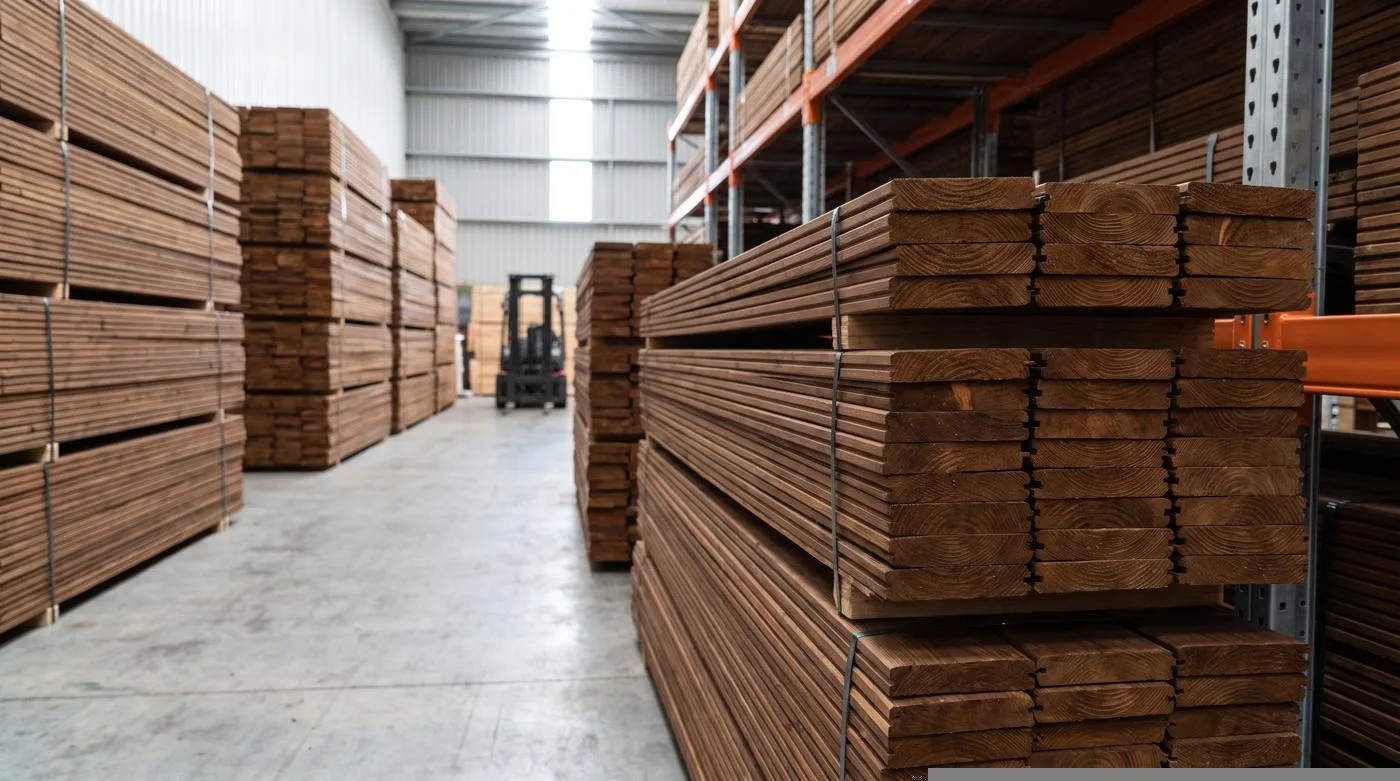
IdeasWood now supplies thermally modified timber to its partners. Cladding, decking, battens and sauna staves in Nordic pine, treated at 212 °C to the Thermo-D level — 17 profiles, 19 of 34 sizes held in stock. This article explains what the material actually is, where it belongs on a building, where it does not, and why it is worth more in a hot climate than a cold one.
What thermally modified wood is
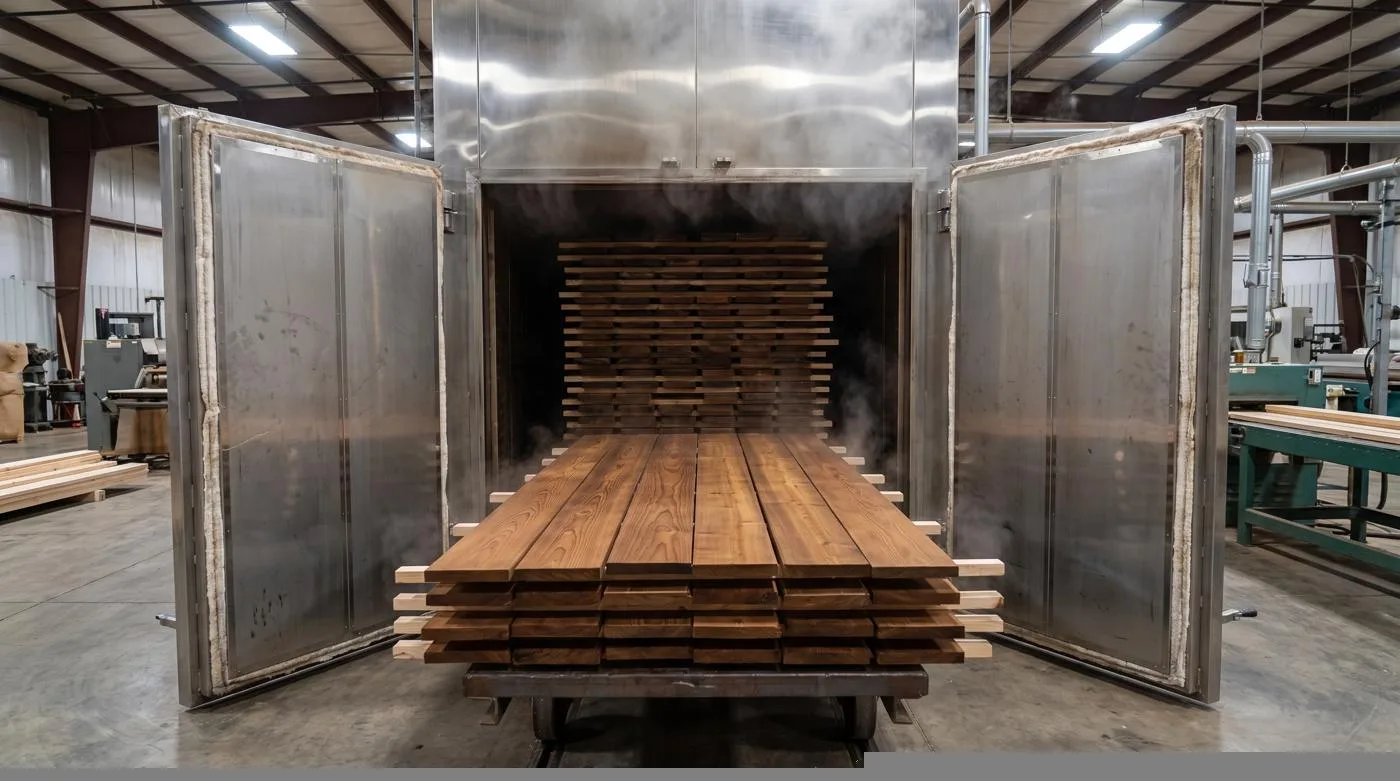
Thermowood is ordinary timber rebuilt by heat. Boards are taken to 212 °C in a chamber under steam, with no chemicals and no preservatives at any stage. What comes out is a different material: darker through its full thickness, considerably more stable, and no longer appetising to the fungi that rot untreated pine.
The chemistry is simple enough. The sugar-rich part of the cell wall — the hemicellulose — decays first, and it is the first thing the heat destroys. Removing it does two things at once. The wood stops absorbing water the way it did, so it swells and shrinks far less, and the food source that rot depends on is largely gone.
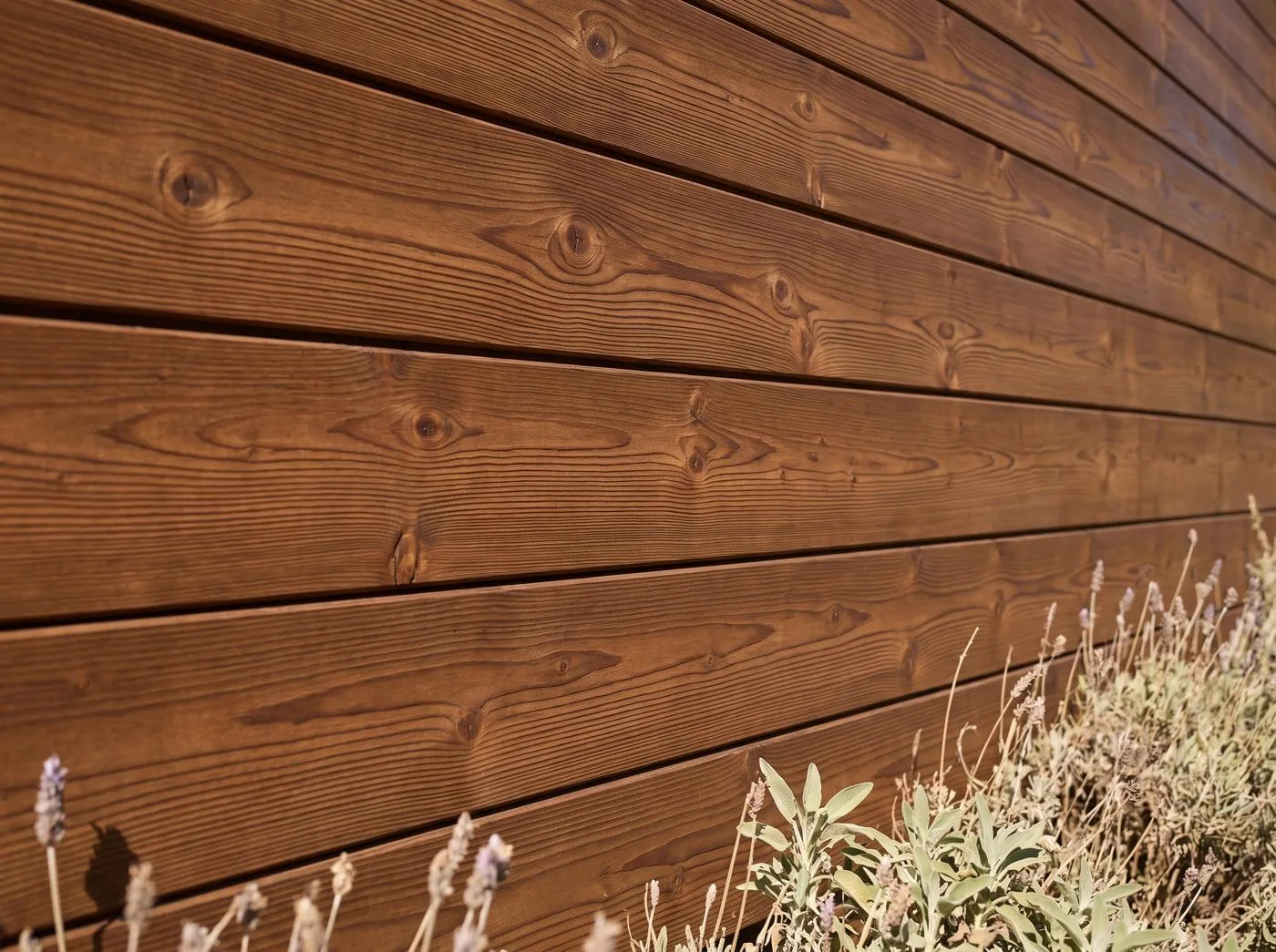
The colour change is a by-product of the same reaction, which is why it runs through the board rather than sitting on the surface. There is no coating to fail, nothing to flake, and nothing to repaint.
Technical data
Thermally modified Scots pine at the Thermo-D level, compared with untreated pine. Wood is a natural material and values vary between batches — this is the working range, not a guarantee.
| Property | Thermowood | Note |
|---|---|---|
| Species | Nordic pine (Pinus sylvestris) | Spruce and ash on request |
| Modification | 212 °C, heat and steam | Thermo-D — the exterior grade of the ThermoWood standard |
| Density | ≈ 420 kg/m³ | Untreated pine ≈ 490 kg/m³; about −14 % |
| Moisture content as delivered | 4–7 % | Source: ThermoWood Handbook 2025 |
| Equilibrium moisture content | Roughly half that of untreated timber | Stays below the 20 % threshold at which decay fungi become active |
| Dimensional stability | Markedly reduced swelling and shrinkage | Peer-reviewed ASE ≈ 24 % for Scots pine at 212 °C. Figures of 60–90 % circulate in the trade with no agreed test method — we do not repeat them. |
| Thermal conductivity | ≈ 13–25 % lower than untreated softwood | No declared W/mK value — request a producer test report if one is needed for a calculation |
| Durability | Class 2 per EN 350, above ground | Above-ground use only. Not for ground or water contact. |
| Expected service life | 30 years uncoated, above ground | Conditional on correct detailing: ventilated cavity, minimum 150 mm ground clearance, stainless fixings |
| Bending strength (MOR) | ≈ 38 N/mm² | Untreated pine ≈ 61 N/mm² (EN 408) |
| Modulus of elasticity (MOE) | ≈ 9 260 N/mm² | Essentially unchanged from untreated pine |
| Screw holding strength | ≈ 19.6 N/mm² (EN 1382) | Untreated pine ≈ 22.2 N/mm²; about −12 % |
| pH | ≈ 4 | Untreated pine 4.5–5. This is why fixings must be stainless. |
| Reaction to fire | To be declared per EN 13501-1 | Since 20 August 2024 thermally modified timber no longer receives an automatic Euroclass. A classification report is available on request, and a fire-retardant variant reaching class B or C can be supplied. |
| Structural use | Not permitted | Cladding, decking and joinery only |
| Lengths | 3.0–5.4 m | Confirm the lengths available for the chosen profile before ordering |
| Surface | Brushed or planed | Brushed or sanded surfaces hold coatings better than planed |
| Dimensional tolerance | Width −2/+4 mm, thickness −1/+3 mm | A nominal 25×125 board finishes at about 24×121 mm — expected, not a defect |
Thermowood or pressure-treated pine?
Both are sold as the outdoor option, and they are not the same product.
Treatment
Thermowood is heat and steam. Pressure treatment is copper-based salts forced into the timber. If the end customer asks what is in the wood, one of those answers is shorter.
Appearance
Thermowood is warm brown through the board. Pressure-treated pine is impregnated green or a coloured tint, where the treatment penetrates and cut ends are not.
Stability
Thermowood moves far less. This matters most on wide boards and on anything where the joint has to stay closed.
End cuts
Thermowood needs no re-treatment at cut ends, because the modification is through the section. Pressure-treated timber does — and on site, that step is skipped more often than it is done.
Cost
Thermowood costs more per square metre, and it is worth being precise about what that buys. It is not extra service life — preservative-treated cladding carries a comparable notional life. What it buys is dimensional stability, appearance, and no biocide in the timber.
Why it earns its price in southern Europe
Most of the arguments for thermowood hold anywhere. Three of them are worth much more the further south the building goes, and they are why our partners in Spain, Portugal, Italy, southern France and Greece specify it rather than painted pine.
The board barely moves
This is the property everything else rests on. Equilibrium moisture content is roughly half that of untreated timber, so the board stops reacting to the weather the way pine normally does. Wide summer-to-winter swings and heavy solar gain are exactly the conditions that open joints, cup boards and pull fixings — and they are the conditions in which a stable board is worth paying for.
It shows up in the things a customer actually notices: joints that stay closed, boards that stay flat on a hot south elevation, and a rainscreen whose shadow gaps still line up in year five. On wide boards and open-joint facades the difference is not subtle.
The resin does not bleed through the finish
This is the failure that ruins painted pine facades in hot countries. Untreated pine carries resin in and around its knots. On a south- or west-facing wall in a Mediterranean summer the surface gets hot enough for that resin to soften, migrate and push through the coating — sticky amber beads on the boards and dark stains spreading around every knot. Repainting does not solve it, because the resin is still in the timber and comes back the following summer.
Thermal modification largely removes the cause. The resin and other extractives are driven off during the 212 °C stage; there is very little left in the board to migrate later. A thermowood facade in a hot climate stays clean where a painted pine one starts spotting in its first two or three summers.
There is no coating for the sun to destroy
UV load in southern Europe is what shortens the life of every film-forming finish. Paint chalks, opaque stains blister and lift, and the repaint interval that is comfortable in northern Europe becomes uncomfortable in the south. Thermowood is brown through the board, so there is nothing to lift. Left alone, it does what it is going to do — greys evenly — and carries on. The honest version of that: strong UV silvers it faster, often within a single season rather than one to two years. If the customer wants the brown kept, the oiling interval in the south is three years, not five.
One point in the other direction, in fairness: it is the same Class 2, above-ground material everywhere. Southern sun does not change the ground clearance, the ventilated cavity or the stainless fixings.
Where we recommend it
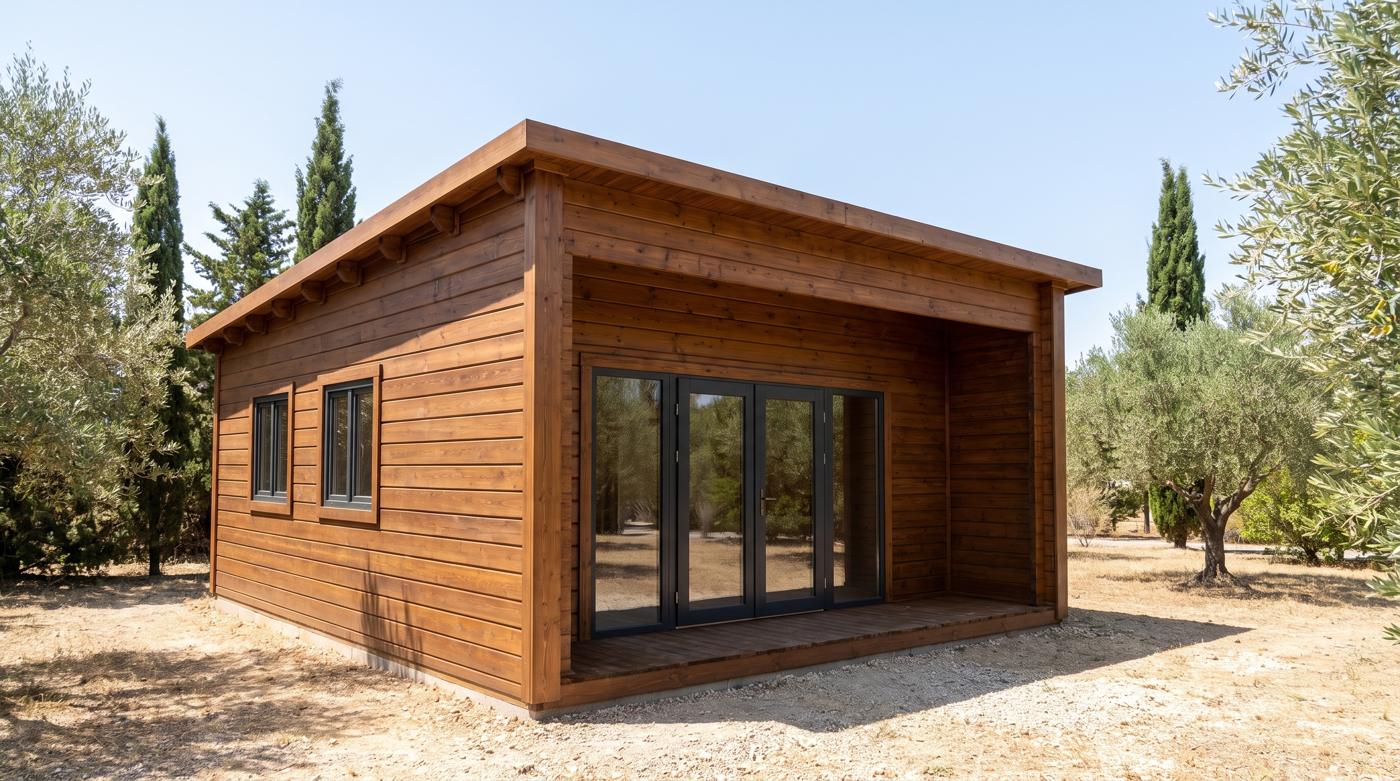
- Garden rooms and garden offices — the facade is what the end customer looks at every day, and there is no repainting conversation in year three.
- Saunas — heat and damp cycling is exactly the condition thermowood was developed for.
- Timber frame houses — a full facade that stays dimensionally quiet through the seasons.
- Hot tub staves, deck slats and screens — constant wet-and-dry cycling.
Where it is not the answer
- Anything load-bearing. The ThermoWood standard prohibits structural use. Bending strength drops roughly a third. Cladding, decking and joinery only.
- Ground contact or standing water. Durability Class 2 is an above-ground rating. It costs more per square metre than pressure-treated timber and will not outlast it in soil.
- Interiors, where the case for it is largely aesthetic.
- Projects with a planning condition specifying a particular timber or finish.
We would rather you heard that from us than from your customer.
On our buildings
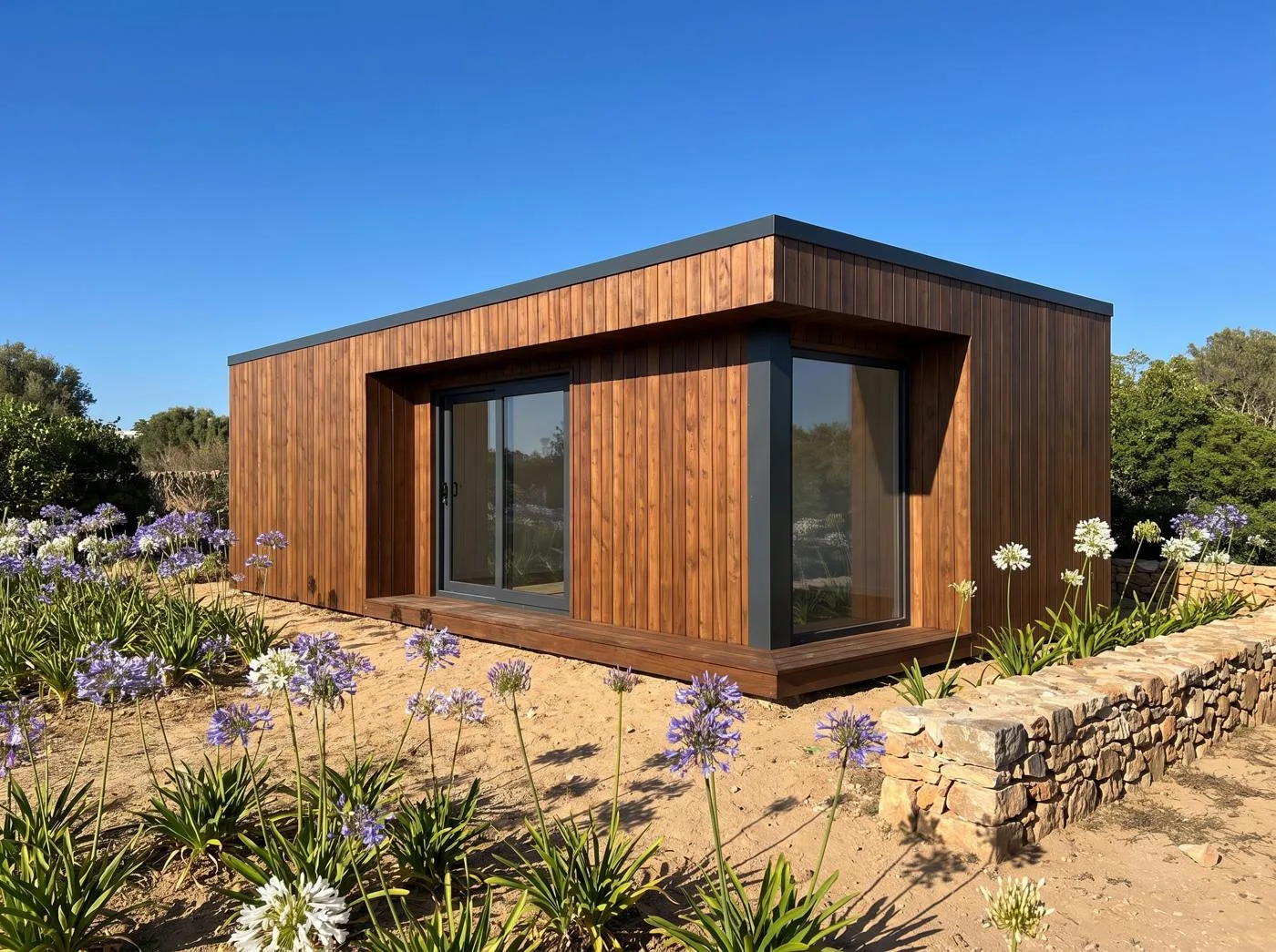
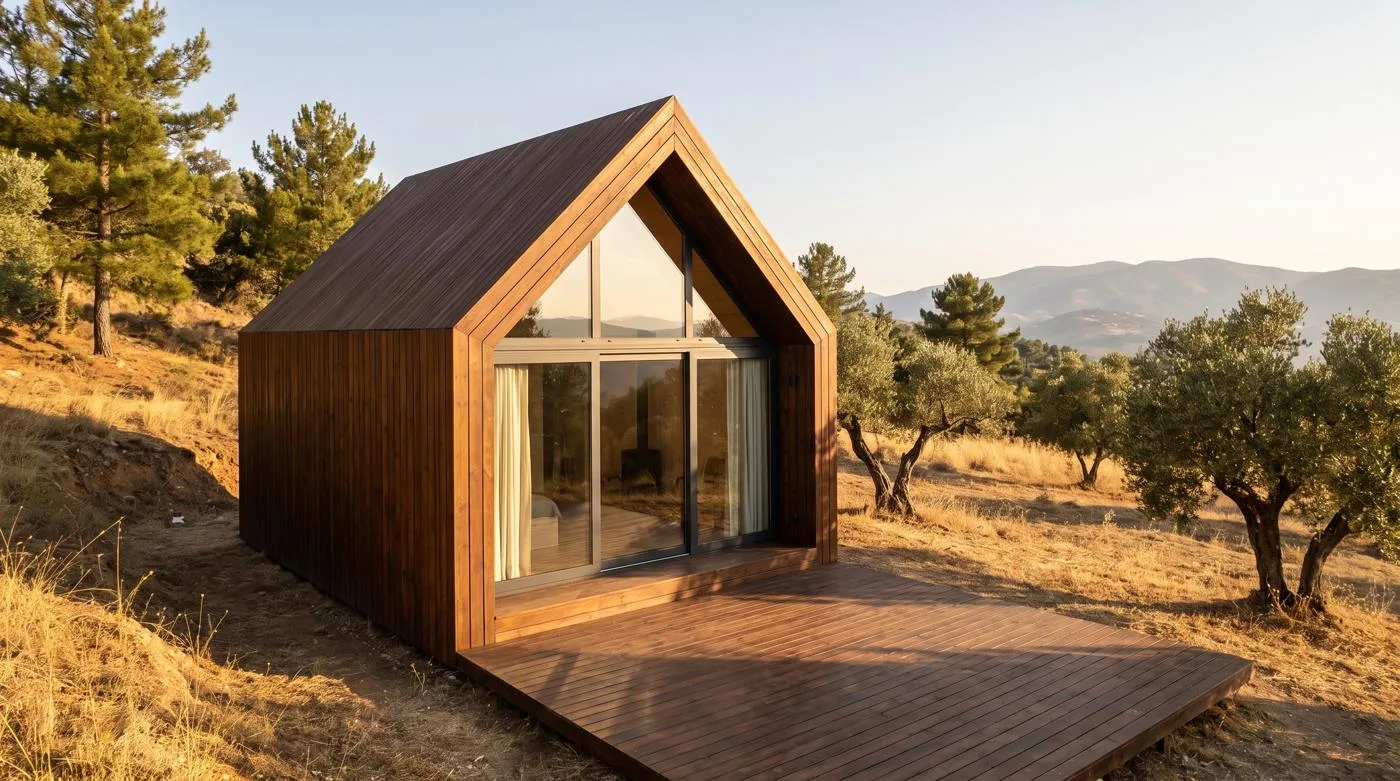
The same range of cabins, garden rooms and timber frame houses we already supply, specified with a thermowood facade instead of painted or untreated pine.
The profiles
Twelve cladding profiles, plus decking, staves and battens — seventeen in all. Nineteen of the thirty-four sizes are held in stock and ship from inventory. The rest are made to order, and a few profiles are not yet priced for the current season — confirm the profile and size with us before you quote a lead time or a price.
Hover over a profile to enlarge it.
| Profile | Code | Description | Thickness × width (mm) | Covers (mm) |
|---|---|---|---|---|
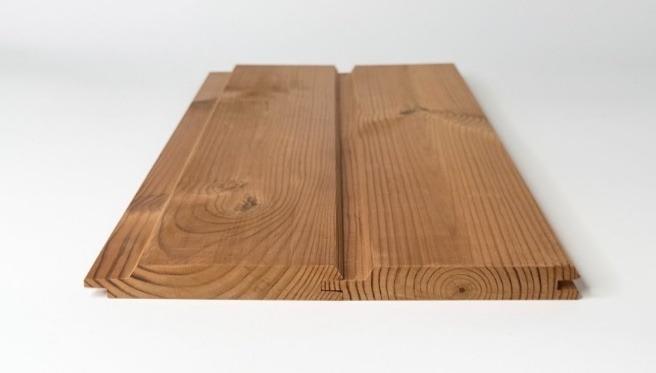 |
TW-01 | Tongue and groove — classic The default horizontal cladding board. Full tongue and groove, closed joint, flat face. |
19 × 92 / 117 / 140 | 82 / 107 / 130 |
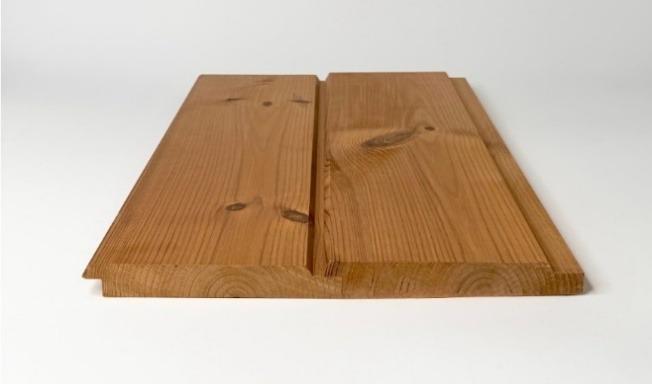 |
TW-02 | Tongue and groove — half lap Half-lap version of the classic board — simpler to fit, works vertically as well as horizontally. |
19 × 92 / 117 / 140 | 82 / 107 / 130 |
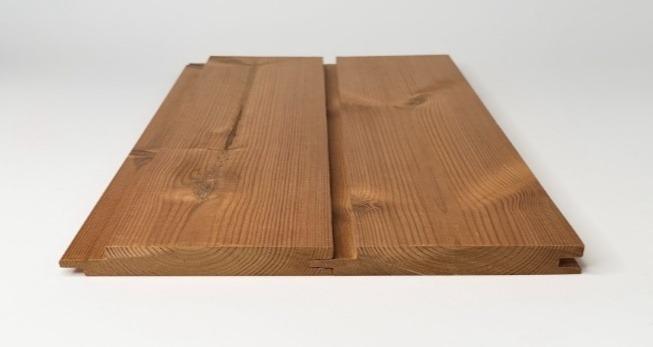 |
TW-03 | Tongue and groove — shadow groove Tongue and groove with a chamfer that throws a shadow line between boards. |
19 × 92 / 117 / 140 | 82 / 107 / 130 |
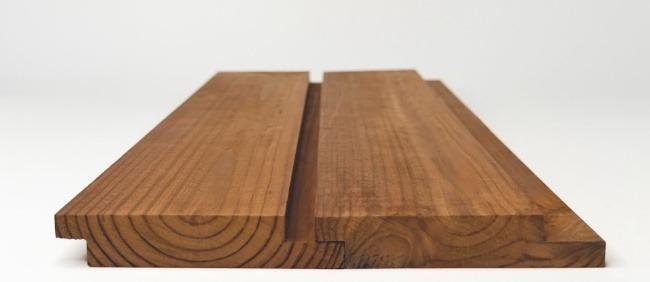 |
TW-04 | Half lap — shadow groove Half lap with the same shadow line. The most forgiving profile to install on an uneven frame. |
19 × 92 / 117 / 140 | 82 / 107 / 130 |
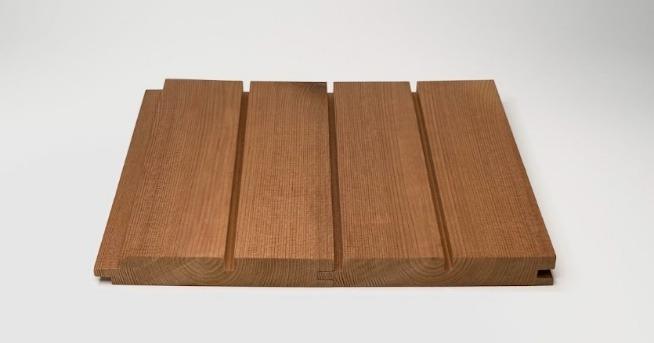 |
TW-05 | Half lap — wide Wide half-lap board. Fewer joints across a large elevation. |
20 × 142 | 132 |
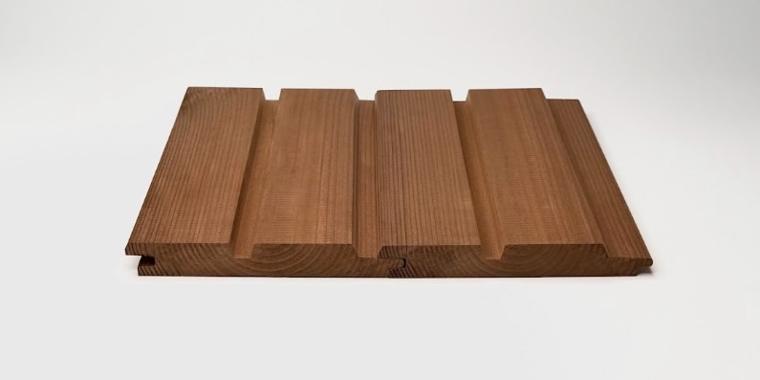 |
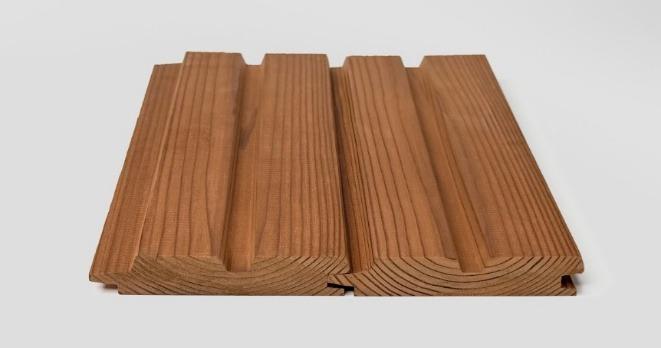
TW-06 | Rhombus — double Two rhombus faces on one board — the open-joint look without open-joint detailing. |
20 × 140 | 132 |
 |
TW-07 | Double groove Two grooves break up the face and give a finer rhythm than the board width suggests. |
19 × 92 | 80 |
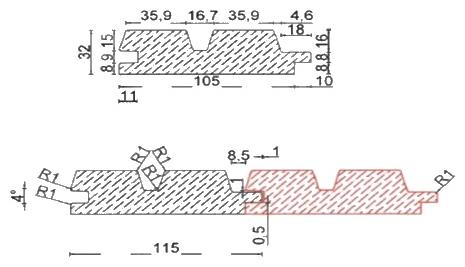 |
TW-08 | Double groove — deep Thick double-groove board, 32 mm. For elevations that need visible depth. |
32 × 115 | 105 |
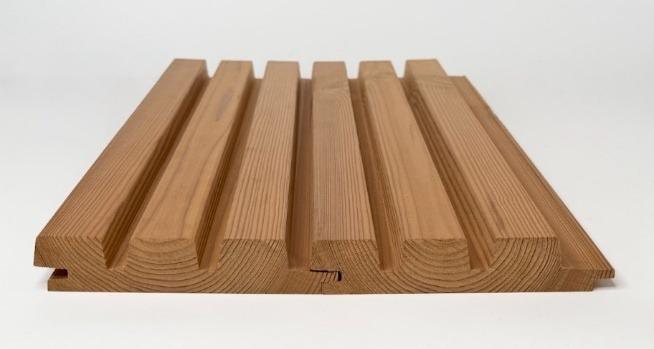 |
TW-09 | Triple groove — 26 mm Three grooves, 26 mm. The most-specified decorative facade board in the range. |
26 × 142 | 132 |
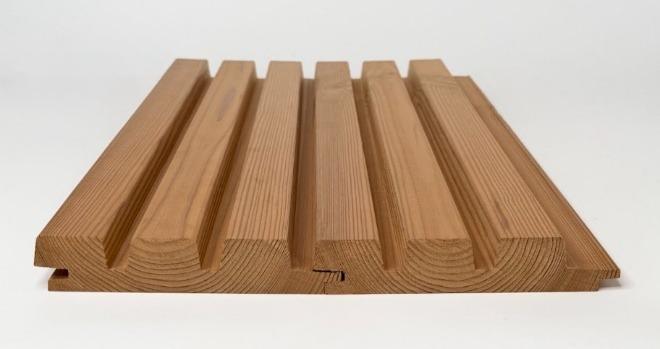 |
TW-10 | Triple groove — 32 mm Triple groove at 32 mm — deeper relief and a heavier shadow. |
32 × 142 | 125 |
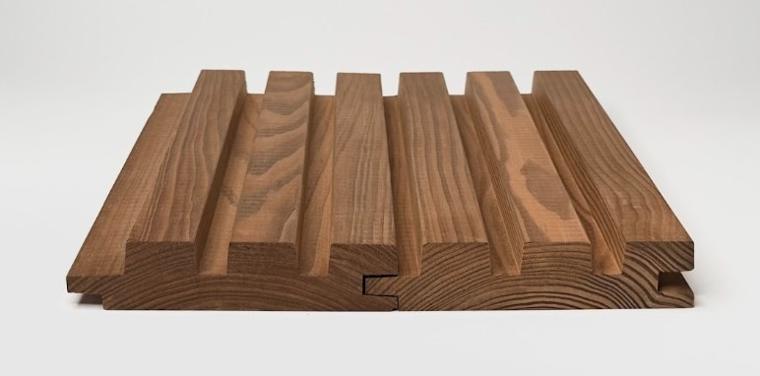 |
TW-11 | Triple groove — wide Triple groove with a wider flat between grooves. |
32 × 142 | 132 |
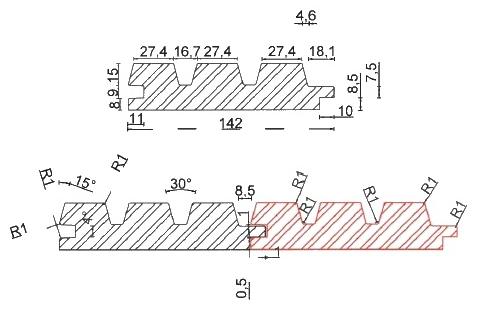 |
TW-12 | Triple groove — deep Triple groove cut deeper for the strongest shadow at distance. |
32 × 142 | 132 |
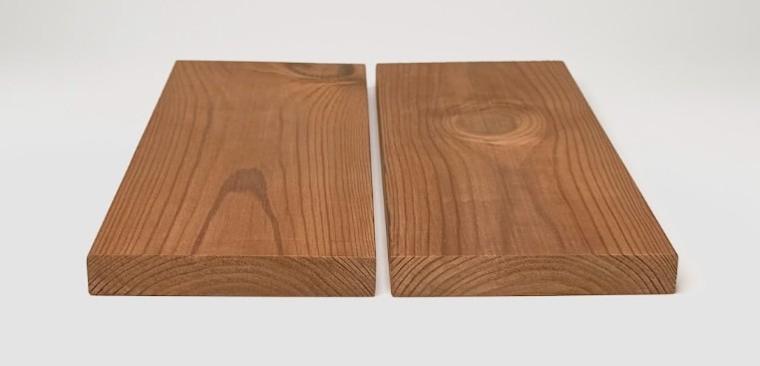 |
TW-13 | Plain board Plain square-edge board. Cladding, soffits, interior linings, and anything you machine yourself. |
19 × 92 / 117 / 140 | 92 / 117 / 140 |
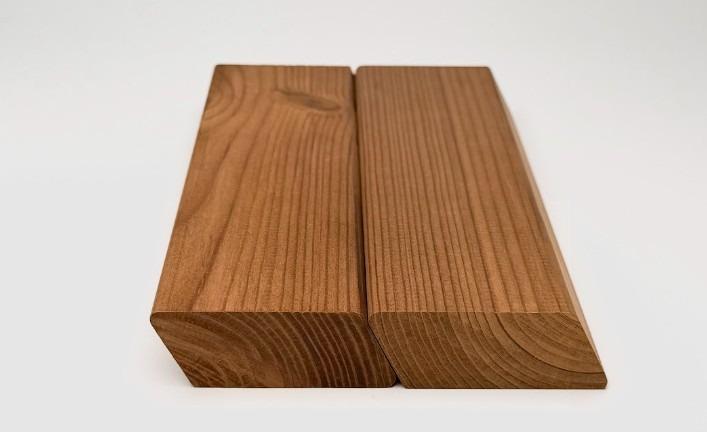 |
TW-14 | Rhombus batten Angled batten for open-joint rainscreen facades. Sheds water by its geometry. |
26 × 68 | 58 |
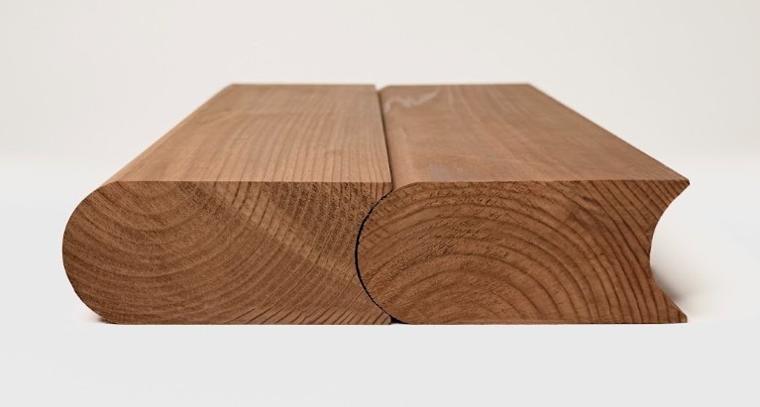 |
TW-15 | Hot tub / sauna stave Rounded stave for hot tubs, barrel saunas and curved surfaces. |
42 × 92 / 117 | 82 / 107 |
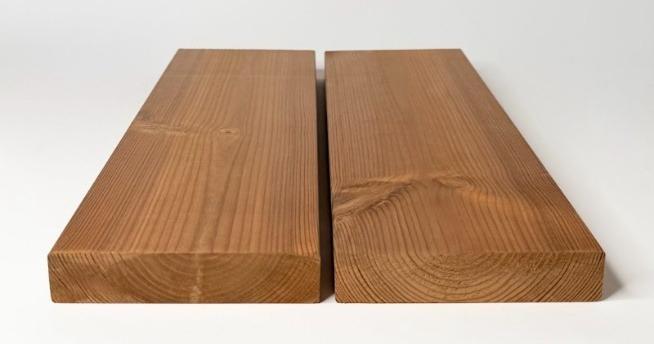 |
TW-16 | Decking board Grooved decking board. Same modification, sized for foot traffic. |
26 × 92 / 117 / 140 | 92 / 117 / 140 |
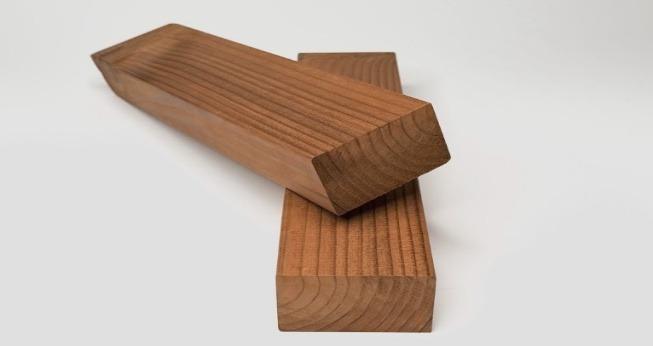 |
TW-17 | Calibrated batten Calibrated batten for substructure, screens and slatted detailing. |
42 × 42 / 68 / 92 / 117 / 140 | 42 / 68 / 92 / 117 / 140 |
Lengths 3.0–5.4 m across the range. Species Nordic pine as standard, spruce and ash to order. Surface brushed or planed. TW-08 and TW-12 are shown as machined sections rather than photographs.
Read the cover width, not the board width
A board is always wider than the surface it shows once fitted, so a facade needs more board area than wall area — up to 15 % more on a tongue-and-groove profile. The Covers column above is the width each board actually shows. Quote from that figure, not from the nominal width, or the material comes up short. Our partners’ price lists already do this conversion.
Installing and looking after it
Fixings
Stainless steel A2 (AISI 304) minimum, indoors and outdoors; acid-resistant A4 (AISI 316) also suitable. The timber is acidic at pH ≈ 4, and ordinary galvanised fixings react with the wood around every screw. Pre-drill near board ends — splitting strength drops by 30–40 % with the modification, so this is not optional. Heads should finish level with the surface — this keeps water out of the fixing hole, not just the hole tight.
Finish and weathering — and whether it needs a coating at all
No coating is required. The durability comes from the modification, not from anything on the surface. The 30-year figure above is the uncoated figure, and it is conditional on detailing — ventilated cavity, ground clearance, stainless fixings — not on a finish. An uncoated facade lasts as long as an oiled one. If anyone tells your customer the wood must be treated to survive, they are describing untreated pine.
What a coating buys is colour, and nothing else. Left alone, the surface greys under UV to an even silver — usually within one to two years, and faster than that under strong southern sun. That is a surface effect with no bearing on service life.
So the decision is simply what the customer wants to look at in five years. Three cases where we would actually put a finish on it:
- The customer wants the brown tone kept. Use a pigmented UV oil — the pigment is what slows the greying; a clear oil barely does. Oil before installation or within three months of it, then every three years on south- and west-facing elevations, or every three to five years elsewhere. In southern Europe, work to the three-year interval.
- Decking and other horizontal surfaces. Not for decay resistance, but because a horizontal board holds standing water and oil keeps the surface from roughening and checking as quickly. Vertical cladding sheds water and does not need this.
- Where an even, controlled appearance matters from day one — a show unit, or a facade that is partly shaded by an overhang, where untreated boards silver at different rates for the first year before evening out.
Three things not to do. No film-forming paint or opaque stain — a film on this material is the one finish that can fail, and putting one on removes the reason you specified thermowood in the first place. No linseed oil, because it feeds fungal growth on this material. And seal every cut end with an end-grain sealer, coated or not.
Ordering
- Availability — 19 of 34 sizes are held in stock and ship from inventory. The rest are made to order, and some profiles are not priced for the current season yet. Ask us before quoting.
- Delivery — FCA Lithuania. We can arrange delivery to your address on request.
- Specify the profile code and the thickness × width, not just “thermowood” — the price range across the profiles is more than double.
- Confirm lengths on every order. 3.0–5.4 m is the span across the range, not guaranteed stock for every profile.
Common questions
Does thermowood need to be oiled or coated?
No. The durability comes from the modification itself, and the 30-year service life figure is the uncoated one. Oiling is a decision about colour, not protection. If the brown tone is to be kept, use a pigmented UV oil; never a film-forming paint or opaque stain, and never linseed oil.
Can thermowood be used for a load-bearing frame?
No. The ThermoWood standard prohibits structural use, and bending strength falls by roughly a third. Use it for cladding, decking and joinery.
Can it go into the ground?
No. Durability Class 2 per EN 350 is an above-ground rating. Keep a minimum 150 mm ground clearance and a ventilated cavity behind the boards.
Why must the fixings be stainless?
The timber sits at about pH 4. Ordinary galvanised fixings corrode and stain the wood around every screw head.
How long does it last?
Around 30 years uncoated and above ground, conditional on correct detailing — ventilated cavity, ground clearance, stainless fixings.
Get the profile list and prices
Partners have the full profile and price workbook in their own order sheet, under Thermowood 2026 Q3. If you are not yet trading with us and want the range, dimensions and trade pricing, email info@ideaswood.eu and we will send the specification guide.
Log cabins · Timber frame houses · PVC windows for log cabins · Contact us